MIC-6 vs G.AL® C250: Two Cast Plates, Two Different Alloys
Last reviewed 2026-07-29 by Team GCA
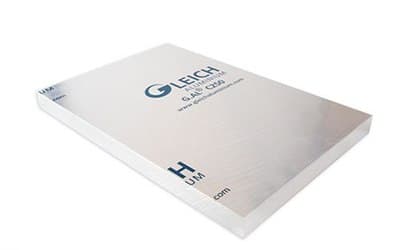
MIC-6 and G.AL® C250 are both cast tooling plates, but they differ in two ways that matter: the alloy family and how the plate is actually produced. MIC-6 uses a 7xxx-series, heat-treatable base. C250 is EN AW-5083, non-heat-treatable, supplied homogenised and stress-relieved to temper O3. That alloy difference drives weldability, anodizing response, food-contact approval and the measured gap in elongation.
This matters because cast tooling plates are widely treated as interchangeable. ATP-5 and Alca 5 are both 5083-based and genuinely close to C250. MIC-6 is the outlier.
If you are buying in Canada, read C250 below as C250 or C210R. Both are EN AW-5083 in temper O3 and share the property data on this page. They differ only in how the faces are finished: C250 is milled to a tight thickness tolerance, C210R is precision sawn with a finishing surplus for shops that will machine both faces anyway. C210R is the grade most Canadian mold shops actually buy, and it is the direct like-for-like against a MIC-6 plate that is going to be machined on both sides. Ask us which one suits the job.
What MIC-6 actually is
Arconic does not publish a chemical composition for MIC-6. Trade descriptions concentrate on the process rather than the metallurgy: cast to near-net thickness, thermally stress-relieved above 700 °F for up to ten hours, then surface ground to final thickness.
G.AL® reaches a finished plate by a different route. The starting point is a rolling slab, cast vertically by the direct-chill process, in GLEICH's case up to 43 in. (1,100 mm) thick. That slab is sawn to thickness and precision milled rather than cast to size. GLEICH then applies its own homogenisation and stress-relief cycle, and states explicitly that heat treatment is where its process differs most from other cast plate producers.
So the shorthand that "both are cast plate" is true but not very informative. One is cast close to its final thickness; the other is cut and machined out of a much larger cast slab and then heat treated to a defined temper.
The alloy family is nonetheless established. GLEICH's comparison datasheet records MIC-6 as 7xxx series, heat treatable, homogenized. Clinton Aluminum describes it independently as a "7000 series base alloy by Alcoa", contrasting it with ATP-5, which they identify as AA 5083.
Density corroborates it. MIC-6 measures 0.101 lb/in³ (2.80 g/cm³); C250 measures 0.096 lb/in³ (2.66 g/cm³). Alloy 5083 sits near 2.66. The 7xxx family sits near 2.80. MIC-6 is in the second group.
The practical takeaway is not that one alloy family is better. It is that substituting between them is not a like-for-like swap, and the properties that change are the ones most likely to matter after the plate is already on the machine.
Measured mechanical properties
The figures below come from GLEICH's comparison testing. Catalogue values are shown alongside measured averages because on two properties the published figure is optimistic, and the measured number is the one that governs how a plate behaves.
Typical values at room temperature. Measured columns are GLEICH test averages.
| Property | Unit | C250 catalogue | C250 measured | MIC-6 catalogue | MIC-6 measured |
|---|---|---|---|---|---|
| Yield strength Rp0.2 | ksi | 16 – 19 | 17.7 | 15 | 15.1 |
| Ultimate tensile Rm | ksi | 33 – 42 | 37.0 | 24 | 23.8 |
| Elongation A5 | % | 10 – 15 | 13.6 | 3 | 1.6 |
| Hardness HBW 2.5/62.5 | – | 68 – 75 | 72.1 | 65 | 60.7 |
Yield strength is close enough to be a non-issue: 17.7 ksi against 15.1. Ultimate tensile strength is not. C250 measured 37.0 ksi against MIC-6's 23.8, a difference of roughly 55%.
Elongation is the figure worth pausing on. C250 measured 13.6%. MIC-6 measured 1.6%, against a catalogue claim of 3%.
Elongation describes how far a material stretches before it breaks. At 1.6% there is effectively no plastic reserve. That does not matter while everything goes to plan, and a fixture plate is rarely stressed near its limit in normal service. It matters when a clamp is overtightened, a plate is dropped on a corner during handling, or a tool crashes. A material with ductility deforms locally and survives. A material without it cracks.
Porosity
GLEICH sectioned and examined samples of both products for internal voids.
| Product | Share of samples in which pores were found |
|---|---|
| G.AL® C250 | 0.83% |
| MIC-6® | 100% |
Pores were present in every MIC-6 sample examined. This is consistent with independent trade descriptions: Clinton Aluminum characterises MIC-6 as having a porous microstructure, in contrast to ATP-5, which they describe as porosity free.
Porosity is not an abstract metallurgical concern. It shows up in four practical ways:
- Cosmetic. A pore intersected by a machined face is a visible pit. It cannot be polished out, because polishing only opens it further.
- Vacuum. A connected pore network is a leak path. This rules the material out of vacuum chambers and fixtures regardless of any other property.
- Anodizing. Pores hold process chemistry and release it later, producing staining and inconsistent colour. This is why MIC-6 anodizing response is rated poor.
- Scrap risk. A subsurface void may only be exposed on the final finishing pass, after every hour of machining time has already been spent on the part.
Where porosity is genuinely critical, neither standard cast plate is the right specification. Vacuum-tight, cleanroom and dynamically loaded work needs a compacted, microporosity-free grade. Contact us before specifying rather than assuming standard cast plate will hold.
Processing characteristics
| Characteristic | G.AL® C250 | MIC-6® |
|---|---|---|
| Dimensional stability | Excellent | Moderate |
| Machinability | Very good | Reasonable |
| Weldability (TIG / MIG) | Good | Unsuitable |
| Corrosion resistance (seawater / weather) | Good | Reasonable |
| Anodizing | Good | Poor |
| Food contact (DIN EN 602) | Yes | No |
Three of these rows are absolute rather than a matter of degree, and each one removes MIC-6 from an entire class of work:
- Welding. MIC-6 is rated unsuitable for TIG and MIG. Any fixture with a welded sub-assembly is out of scope.
- Food contact. MIC-6 is not approved under DIN EN 602, which excludes food processing and packaging tooling.
- Anodizing. Poor response rules out cosmetic, colour-matched and hard-anodized work.
One qualification in the interest of accuracy: C250 is also unsuitable for hand welding. Where a welded construction is required in the 5083 family, specify C210R or rolled 5083 rather than C250.
Physical properties
| Property | Unit | G.AL® C250 | MIC-6® |
|---|---|---|---|
| Density | lb/in³ | 0.096 | 0.101 |
| Density | g/cm³ | 2.66 | 2.80 |
| Modulus of elasticity | ksi × 10³ | 10.2 | 10.2 |
| Thermal conductivity | BTU/ft·hr·°F | 64 – 75 | 82 |
| Coefficient of thermal expansion | 10⁻⁶/°F | 13 | 13.1 – 13.6 |
Stiffness is identical, which is expected: modulus barely varies across aluminium alloys, so neither plate will deflect less than the other under load.
MIC-6 conducts heat better, 82 against 64-75 BTU/ft·hr·°F. Where a fixture is expected to pull heat away from a part, that is a point in its favour. It is also the reason MIC-6 needs more careful thermal management during any welding attempt, which is academic given it is unsuitable for welding anyway.
The density difference has a mundane consequence worth noting: an equally sized MIC-6 plate is roughly 5% heavier. On a large mold base handled by one person, that is occasionally the deciding factor.
Where this comparison has limits
Two limits, stated plainly.
First, the measured values above are GLEICH's own testing. They are from our comparison programme, not an independent laboratory, and we have an obvious interest in the outcome. The alloy classification and the porosity characterisation are corroborated by third parties; the specific tensile and elongation averages are not. Ask us for the test conditions if the numbers matter to your decision.
Second, MIC-6 has decades of successful service in exactly the applications discussed here. Shops using it for dry-machined jigs and fixtures, with no welding, no anodizing and no food contact, are not making a mistake. The argument is not that MIC-6 fails. It is that it is a different alloy family than most buyers assume, and the differences show up in specific, predictable places.
Specification summary
| If the work involves | Then |
|---|---|
| Welded fixture sub-assemblies | MIC-6 excluded. Specify C210R or rolled 5083 |
| Food processing or packaging | MIC-6 excluded (not DIN EN 602). Specify C210R or C250 |
| Anodized or colour-matched surfaces | Contact us; on cast plate this depends on the grade |
| Vacuum or cleanroom service | Contact us; needs a low-porosity grade, not standard cast plate |
| Impact or handling risk | Favour C250 on elongation, 13.6% against 1.6% |
| Cosmetic machined or polished faces | Favour C250 on porosity |
| Heat extraction from the part | MIC-6 conducts better, 82 vs 64-75 BTU/ft·hr·°F |
| Dry-machined jigs, no welding or anodizing | Both are suitable |
Frequently asked questions
Is MIC-6 the same as 5083?
No. MIC-6 uses a 7xxx-series, heat-treatable base alloy. G.AL® C250, ATP-5 and Alca 5 are all based on 5083, which is non-heat-treatable. Arconic does not publish MIC-6's composition. The density difference is measurable: 0.101 lb/in³ for MIC-6 against 0.096 for C250.
What alloy is MIC-6?
A 7xxx-series base alloy produced by Arconic. The exact composition is proprietary and not published, which is why sources describe it by trade name and process rather than by alloy number.
Is G.AL® C250 a direct replacement for MIC-6?
For most machined tooling applications, yes, and it removes three restrictions MIC-6 carries: welding, food contact and anodizing. It is not a metallurgical equivalent. Where the design depends on MIC-6's higher thermal conductivity, confirm the substitution first.
Which has less porosity?
G.AL® C250 by a wide margin. GLEICH found pores in 0.83% of C250 samples and 100% of MIC-6 samples. For pore-critical work such as vacuum service, contact us before specifying.
Can MIC-6 be welded?
It is rated unsuitable for TIG and MIG welding. Note that C250 is also unsuitable for hand welding. For welded constructions specify C210R or rolled 5083.
Can MIC-6 be used for food processing tooling?
No. MIC-6 is not approved for food contact under DIN EN 602. The 5083-based G.AL® grades, including C250 and C210R, are.
Why does MIC-6 anodize poorly?
Two reasons combine: the 7xxx-series base alloy and the porosity. Pores retain process chemistry and release it after sealing, producing staining and inconsistent colour. For anodized work, contact us before specifying.
Availability in Canada
Stocked in Oldcastle, Ontario
G.AL® plate is stocked in Oldcastle, Ontario, roughly ten minutes from the Windsor-Detroit border. Standard formats ship the same or next business day to most of Southwestern Ontario, and across Canada on a freight quote.
Pickup is available Mon–Fri, 8:00 AM – 4:30 PM ET at 2555 North Talbot Road, Oldcastle, ON N0R 1L0, Canada. Every delivery includes the EN 10204 3.1 inspection certificate for that specific lot at no charge.
Off-cuts and remnant pieces are listed with exact dimensions and prices in the G.AL® Shop.
Your Aluminum Experts in Canada
Our Canadian team understands mold making. Tell us your application and we will recommend the right G.AL® grade, thickness, and format - and get you a quote fast.