Cast 5083 vs 6061: Which Plate Holds Tolerance?
Last reviewed 2026-07-29 by Team GCA
Specify cast 5083 when the part must hold tolerance through material removal. Specify 6061-T651 when the part must carry load. 6061-T651 is the stronger and harder material by a clear margin. Cast 5083 in the homogenized, stress-relieved O3 condition has very low residual stress, so it does not move when you open it up. For fixtures, jigs and mold bases, that stability is what governs.
The supporting figures below are from GLEICH comparison datasheets. Where the 6061 column shows a minimum, that is the specified minimum rather than a typical value, and it is labelled accordingly.
The alloy is not the manufacturing route
"5083" specifies chemistry: an aluminium-magnesium alloy, non-heat-treatable, strengthened by work hardening rather than by precipitation. It says nothing about how the plate reached final form, and for precision machining the route matters more than the chemistry.
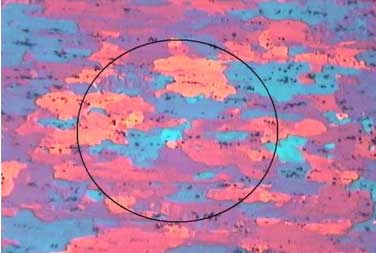
Rolled plate is reduced between rolls under high pressure. Grains elongate along the rolling direction, which produces an anisotropic structure whose properties differ with orientation. The reduction also stores residual stress through the section.
Cast plate starts from exactly the same material. Both routes begin with a rolling slab, cast vertically by the direct-chill process, one ingot at a time. GLEICH's run up to 43 in. (1,100 mm) thick. The plate itself is not cast to size.
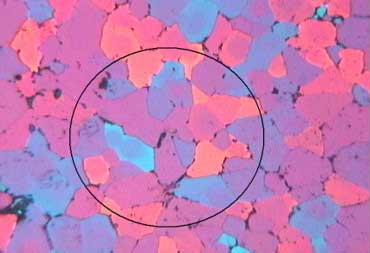
What differs is everything after the slab. G.AL® plate is sawn to thickness and then precision milled, so almost no forming force is applied and the slab's original grain structure survives intact into the finished plate. It stays granular and isotropic instead of being stretched into a direction.
The second half is the heat treatment. GLEICH applies its own homogenisation and stress-relief cycle, which for 5083 produces temper O3. GLEICH states plainly that this is where its process differs most from other cast plate producers, and it is the step that makes the plate dimensionally predictable rather than merely cast.
This distinction has a commercial consequence. A search for "5083 plate" mostly returns rolled marine and structural stock, which is a legitimate and completely different product. If the work is welded, formed or structural, buy rolled plate. If it is machined to tolerance, specify cast.
Cast plate is excluded from bending, forming and pressure vessel construction. These are hard exclusions, not preferences. Cast plate has insufficient reserve ductility for forming, and pressure vessel construction is a regulatory exclusion regardless of measured properties.
The four rows that actually decide it
Strength tables get the attention. For tooling, these four properties matter more, and they are the ones a strength table does not show.
| Property | G.AL® cast 5083 (O3) | 6061 |
|---|---|---|
| Residual stresses | Very low | High |
| Dimensional stability | Excellent | Poor to very poor |
| Homogeneity through thickness | Yes | No |
| Properties change over thickness, width, length | No | Yes |
Those are GLEICH's own datasheet ratings, and "poor to very poor" is a blunt assessment of a material that is otherwise excellent at many things. It reflects one specific failure mode.
6061-T651 arrives carrying stress from two sources: mechanical work during rolling, and the quench during solution heat treatment and artificial ageing. The T651 designation indicates a stretch-relief operation, which reduces stress but does not remove it through the section.
The consequence appears on the second setup, not the first. Rough a pocket into a 6061-T651 plate and stress that was balanced across the section is no longer balanced. The plate relaxes into a new shape. Shops manage this with rough-and-rest cycles, an intermediate stress-relief step, or by machining oversize and coming back for a finish pass. All of it is spindle time and handling.
The homogeneity rows compound it. In rolled plate, properties vary between the edge and the centre of the original slab, and through the thickness. Across a run of nominally identical parts that shows up as uneven tool wear and drifting surface finish, which is harder to diagnose than outright movement because the parts still measure acceptable until they do not.
What the distortion actually measures
Ratings like "very low" and "high" are only as good as the testing behind them. GLEICH measured it. Specimens of each material were tested for deviation from flat over a 10 in. length.
Distortion from flat, measured over a 10 in. length. GLEICH test data.
| Material | Route | Distortion |
|---|---|---|
| G.AL® C250 | Cast, sawn and milled | 0.010 in. |
| G.AL® C330 | Cast, sawn and milled | 0.026 in. |
| EN AW-5083 | Rolled | 0.055 in. |
| EN AW-6061 | Rolled | 0.072 in. |
| EN AW-7075 | Rolled | 0.100 in. |
C250 moved 0.010 in. Rolled 6061 moved 0.072 in. Roughly seven times as much. Against rolled 7075 the ratio is ten to one.
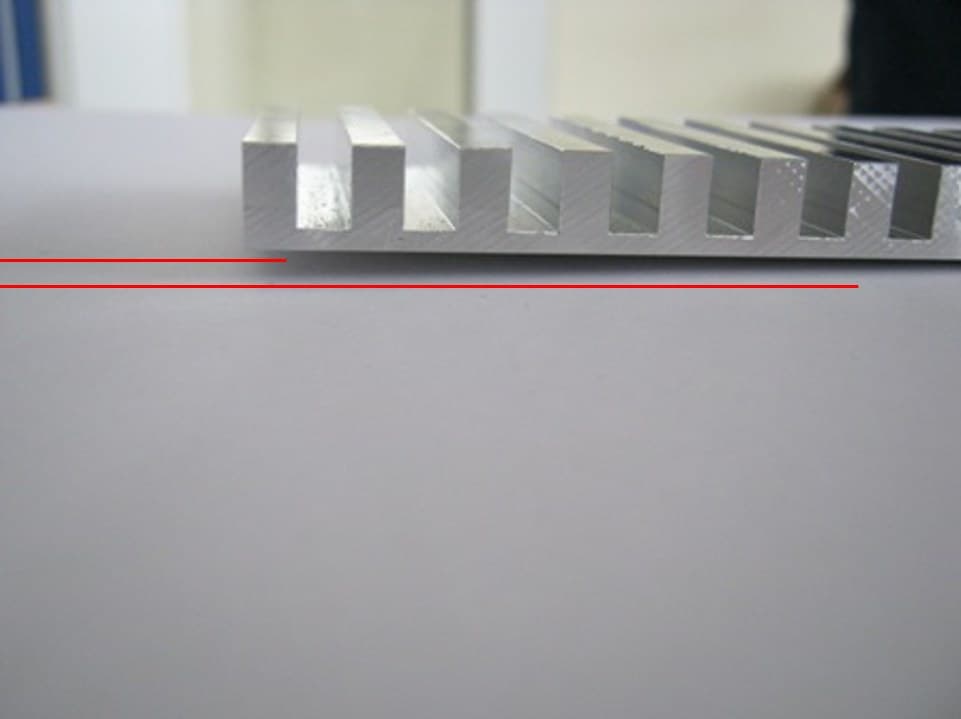
The most useful row is neither of those. It is rolled 5083 at 0.055 in.
That is the same alloy as C250. Same chemistry, same magnesium content, same non-heat-treatable behaviour. The only variable is how the plate was made, and it distorts five and a half times more. This is the cleanest evidence in the whole comparison that the stability comes from the route and the heat treatment, not from the alloy on the certificate.
It also explains why buying "5083 plate" to get G.AL® behaviour does not work. The designation on the mill certificate is the same. The material does not behave the same.
These are GLEICH's own measurements rather than an independent laboratory's, and we have an obvious interest in the result. The relative ranking is consistent with what shops report anecdotally about 7075 and 6061, but ask us for the test conditions if the absolute numbers matter to your decision.
Mechanical properties
Typical values at room temperature. 6061 figures are specified minima.
| Property | Unit | G.AL® 5083 (O3) | 6061-T4 / T451 | 6061-T6 / T651 |
|---|---|---|---|---|
| Yield strength Rp0.2 | ksi | 16 – 19 | min. 15.9 | min. 31.9 |
| Ultimate tensile Rm | ksi | 33 – 42 | min. 29.7 | min. 37.7 |
| Elongation A5 | % | 10 – 15 | min. 12 | min. 2 |
| Hardness HBW 2.5/62.5 | – | 68 – 75 | 58 | 80 – 88 |
6061-T651 is stronger. Roughly double the yield strength and meaningfully harder. Where a component is stress-limited, that settles the question and cast 5083 is the wrong specification.
Fixtures and mold bases are rarely stress-limited. They are tolerance-limited.
Note the elongation row, which is easy to skim past. Cast 5083 runs 10 to 15%. 6061-T651 has a specified minimum of 2%. In the T4 condition 6061 is ductile, at minimum 12%, but T4 is not the temper anyone buys for tooling. The fully aged T651 plate that shops actually use has very little reserve before fracture.
Tolerances and flatness
This is the widest gap in the entire comparison, and it is the one that shows up as cost on the first setup.
| Dimension | G.AL® C250 (milled) | G.AL® C210R (sawn) | 6061 |
|---|---|---|---|
| Thickness | ± 0.004 in. | −0 / +0.100 in. (≤ 5.90 in.) | ± 0.011 – 0.145 in. |
| Thickness, over 5.90 in. | – | −0 / +0.200 in. | – |
| Width | −0 / +0.790 in. | −0 / +0.375 in. | −0 / +0.275 to +0.433 in. |
| Length | −0 / +0.790 in. | −0 / +0.790 in. | −0 / +0.275 to +0.433 in. |
| Flatness, under 0.500 in. thick | 0.015 in. | – | 0.118 up to 0.472 in. |
| Flatness, over 0.500 in. thick | 0.005 in. | – | 0.118 up to 0.472 in. |
Read the flatness rows twice. C250 is held to 0.005 in. over half-inch thickness. The 6061 specification allows up to 0.472 in. That is not a marginal difference in grade; it is a different category of product, because rolled plate is not sold as a machining-ready surface.
The thickness comparison is nearly as stark: ±0.004 in. against ±0.011 to 0.145 in.
The practical effect is a whole operation. A C250 plate arrives ready to machine, precision milled on both faces to Ra 0.4 µm with protective PVC film on both sides. There is no facing pass to establish a datum, no material paid for and turned into chips, and no setup spent getting flat before starting the actual work. A 6061 plate is supplied rolled, or rolled and brushed, and that work is yours to do.
C210R is the sawn mold plate rather than the milled product, so its thickness tolerance is open by comparison and it includes a minimum 0.125 in. finishing surplus. It is specified where the shop intends to machine both faces anyway.
What it costs on the machine
Stability and tolerance are worth arguing about only if they show up on an invoice. GLEICH costed a specific job: a finished base plate of 2.4 × 15.7 × 39.4 in. (60 × 400 × 1,000 mm), machined from each material. The figures below are recalculated at a CAD 125 per hour shop rate, with one hour of setup.
Same finished part, four materials. CAD 125/h machine rate plus one hour setup. Material cost is NOT included - see below.
| Rolled 7075 | Rolled 6082 / 6061 | C210R / C330R | C250 / C330 | |
|---|---|---|---|---|
| Stock thickness required | 2.76 in. | 2.76 in. | 2.56 in. | 2.36 in. |
| Weight of stock | 175 lbs | 170 lbs | 155 / 163 lbs | 143 / 150 lbs |
| Machining time | 3.25 h | 2.75 h | 1.74 h | 1.22 h |
| Machining cost | $406.25 | $343.75 | $217.50 | $152.50 |
| Setup (1 h) | $125.00 | $125.00 | $125.00 | $125.00 |
| Machining + setup | $531.25 | $468.75 | $342.50 | $277.50 |
Against rolled 6082, the European counterpart to 6061 and the closest analogue in the study, C250 took 1.22 hours instead of 2.75. That is 56% less machining time and CAD 191 less per part in machine and setup time, a 41% reduction. Against 7075 the saving is CAD 254 per part.
The first row explains most of it. C250 is bought at 2.36 in., which is the finished thickness. Rolled plate has to be bought at 2.76 in., because the thickness has to be machined in. Every part therefore starts with a facing operation on both faces, and roughly 16% more metal is purchased in order to convert it into chips.
The remainder is the absence of stress management: no rough-and-rest cycle, no intermediate stress relief, no returning for a second finish pass because the plate moved.
Read this table as machining economics, not as the price of the job. It covers machine time and setup only. Material is not included, and cast plate costs more per pound than rolled 6061. The honest decision rule follows directly: cast plate wins outright whenever the price premium on the plate is less than the machining saving - here, CAD 191 per part against 6061. On a one-off that is often marginal. Across a production run of identical parts it rarely is, and the saving repeats on every piece while the premium is paid once per plate.
Two limits worth stating. The study is GLEICH's own, using a German cost model that we have recalculated at CAD 125/h. And the machining times come from that study rather than from your shop. The hours and the stock weight are the parts that travel - those are properties of the material rather than of the rate you charge. Substitute your own rate and the ratio holds.
Physical properties and service temperature
| Property | Unit | G.AL® 5083 (O3) | 6061 |
|---|---|---|---|
| Density | lb/in³ | 0.096 | 0.097 |
| Modulus of elasticity | ksi × 10³ | 10.2 | 10.2 |
| Thermal conductivity | BTU/ft·hr·°F | 64 – 75 | 97 – 102 |
| Electrical conductivity | %IACS | 29 – 32 | 44 |
| Coefficient of thermal expansion | 10⁻⁶/°F | 13.1 | 12.9 |
| Max service temp, long / short term | °F | 356 / 536 | 248 / 330 |
Stiffness is identical. Modulus barely varies across aluminium alloys, so neither plate deflects less than the other under load, whatever the strength difference suggests.
Cast 5083 tolerates considerably more heat: 356 °F long-term against 248 °F, and 536 °F short-term against 330 °F. For fixtures near ovens, presses, heated platens or wash lines, that margin is the deciding property rather than strength.
Where 6061 is the better choice
A comparison that concedes nothing is not worth reading. Four places where 6061 genuinely wins:
- Strength. Roughly double the yield strength in T651. For load-bearing and structural components this is decisive.
- Anodizing. Rated very good, against good for cast 5083. For decorative and colour-critical work 6061 is the easier material.
- Thermal conductivity. 97 to 102 against 64 to 75 BTU/ft·hr·°F. Where the part must move heat, 6061 moves it faster.
- Cost and availability. 6061 is a commodity, stocked everywhere, in far more sizes. For a bracket that does not need to hold a tenth, cast plate is over-specified.
Both materials are approved for food contact under DIN EN 602, and both weld acceptably by TIG and MIG. One qualification on our side: C250 is not suitable for hand welding. For welded constructions specify C210R or rolled 5083.
Specification summary
| Application | Specify | Because |
|---|---|---|
| Mold base, cavity plate, backing plate | G.AL® C250 or C210R | Very low residual stress; holds tolerance |
| Inspection fixture, jig, checking gauge | G.AL® C250 | Flatness 0.005 in. and ±0.004 in. thickness |
| Fixture near heat, up to 356 °F | G.AL® cast 5083 | 6061 is limited to 248 °F long-term |
| Vacuum or cleanroom component | Contact us | Needs a low-porosity grade; standard cast plate is not specified for vacuum service |
| Anodized or colour-matched surface | 6061, or contact us | 6061 anodizes very well; on cast plate this needs a grade selected for it |
| Load-bearing structural component | 6061-T651 | Roughly double the yield strength |
| Welded fabrication | C210R or rolled 5083 | C250 unsuitable for hand welding |
| Formed, bent or pressure-retaining part | Rolled plate, never cast | Hard exclusion |
| Non-critical bracket or spacer | 6061 | Cast plate is over-specified |
Frequently asked questions
How much does 6061 distort compared to cast 5083?
In GLEICH testing over a 10 in. length, cast G.AL® C250 deviated 0.010 in. from flat and rolled 6061 deviated 0.072 in., roughly seven times as much. Rolled 7075 reached 0.100 in. Notably, rolled 5083 - the same alloy as C250 - still moved 0.055 in., which shows the difference comes from the manufacturing route and heat treatment rather than the alloy.
Does cast plate actually save machining time?
In a GLEICH cost study of a 2.4 x 15.7 x 39.4 in. base plate, C250 took 1.22 hours against 2.75 hours for rolled 6082, a 56% reduction. At a CAD 125/h shop rate that is about CAD 191 less per part in machine and setup time. Two reasons: C250 is bought at finished thickness so no facing operation is needed, and there is no stress-relief or rough-and-rest cycle to work around. Note this covers machining only - cast plate costs more per pound, so it wins outright when the plate premium is less than the machining saving.
Is 5083 stronger than 6061?
No. 6061-T651 has roughly double the yield strength, a specified minimum of 31.9 ksi against 16 to 19 ksi for cast 5083 in O3 temper, and it is harder. Cast 5083 is specified for dimensional stability, not strength.
What is the difference between cast 5083 and rolled 5083?
The same alloy and the same starting slab, processed differently. Both begin as the same cast rolling slab. Rolled plate is then reduced to thickness by force, which elongates the grain and stores stress. Cast plate is sawn to thickness and precision milled, so the slab's granular, isotropic structure survives, and GLEICH's homogenisation and stress-relief cycle then sets temper O3.
Why does 6061 move when I machine it?
Residual stress. Rolling and the quench during heat treatment leave stress balanced through the section. Removing material asymmetrically unbalances it and the plate relaxes into a new shape. GLEICH rates 6061 dimensional stability as poor to very poor for this reason, against excellent for cast 5083 in O3.
How flat is cast plate compared to 6061?
G.AL® C250 is held to 0.015 in. below half-inch thickness and 0.005 in. above. The 6061 specification allows 0.118 up to 0.472 in. C250 also arrives precision milled to Ra 0.4 µm, so no facing pass is needed.
Can I use cast plate at elevated temperature?
Cast 5083 is rated to 356 °F long-term and 536 °F short-term, against 248 °F and 330 °F for 6061. For fixtures near ovens, presses or heated platens, cast 5083 has the larger margin.
Which anodizes better?
6061, rated very good against good for cast 5083. For colour-critical or decorative work on cast plate, contact us before specifying - reproducible anodizing depends on the grade.
Can cast 5083 be welded?
C210R welds acceptably by TIG and MIG. C250 is not suitable for hand welding. For welded constructions specify C210R or rolled 5083.
Availability in Canada
Stocked in Oldcastle, Ontario
G.AL® plate is stocked in Oldcastle, Ontario, roughly ten minutes from the Windsor-Detroit border. Standard formats ship the same or next business day to most of Southwestern Ontario, and across Canada on a freight quote.
Pickup is available Mon–Fri, 8:00 AM – 4:30 PM ET at 2555 North Talbot Road, Oldcastle, ON N0R 1L0, Canada. Every delivery includes the EN 10204 3.1 inspection certificate for that specific lot at no charge.
Off-cuts and remnant pieces are listed with exact dimensions and prices in the G.AL® Shop.
Your Aluminum Experts in Canada
Our Canadian team understands mold making. Tell us your application and we will recommend the right G.AL® grade, thickness, and format - and get you a quote fast.