Aluminum vs Steel Injection Molds: Cycle Time, Tool Life and What It Actually Costs
Last reviewed 2026-08-07 by Wolf Nawratil, Technical Product Manager, GLEICH Aluminium
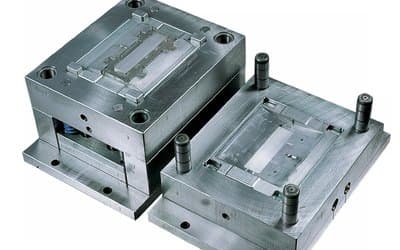
Aluminum wins on cycle time and loses on tool life. Which of those matters more is decided by the total piece count, not by the price of the mold. The most expensive mistake in this decision is quoting the mold in isolation. A mold is a capital item bought once; the cycle time is a cost paid on every shot for the life of the program, and on a long-running job it is the far larger number.
This article covers thermoplastic injection moulding. The figures are from a GLEICH technical study, and the tool life guidance at the end also covers polyurethane and elastomer work, where the answer is frequently that aluminum is the wrong material.
One note on the money. The study was costed in Germany and the figures below are converted at CAD 1.6161 per EUR, the Bank of Canada rate for 2026-08-06. The machine rate is a converted German rate, not a surveyed Ontario rate. Use your own. The conclusion does not depend on it, and the reason why is set out after the table.
The system cost, worked through
The example is a moulded ABS cover. The outer face carries a simple waffle texture, so the cavity has to be etched. The inner face has several retaining claws, which are undercuts, released by hydraulic slides so the finished part drops out under gravity and no ejectors are needed.
- Total quantity: 20,000,000 pieces
- Two-part mold with 10 cavities, so 20,000,000 parts is 2,000,000 shots
- Compared: steel St37 (S235JR) against G.AL® C330R cast aluminum plate
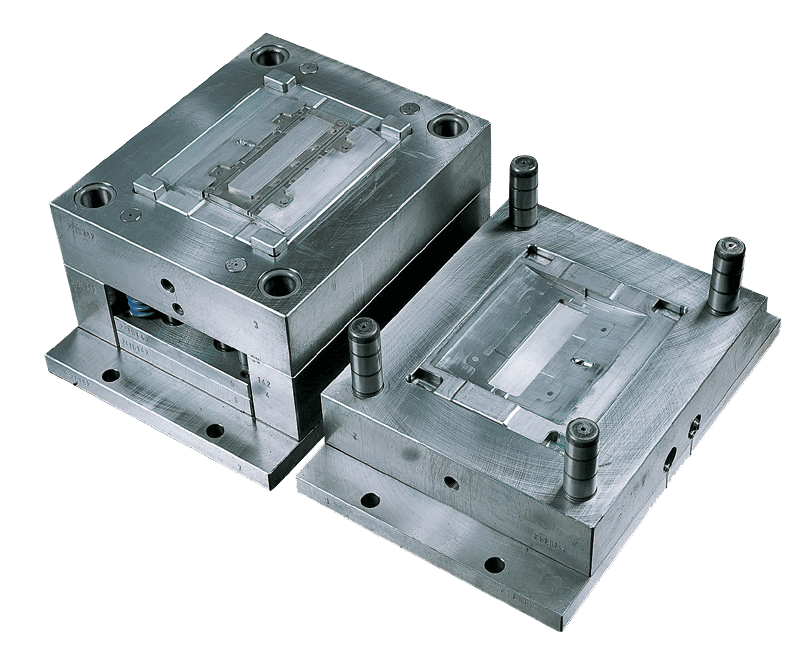
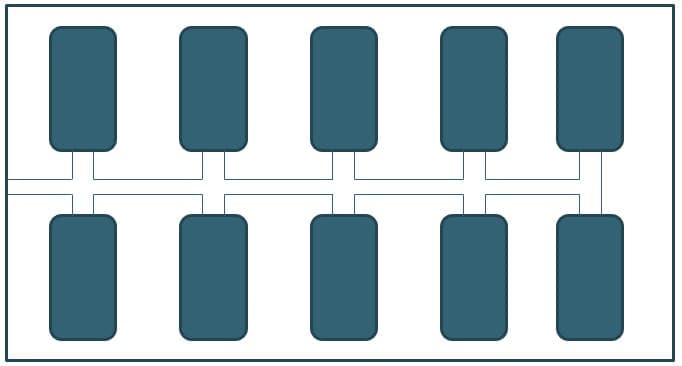
First, the plate. The aluminum mold is built slightly heavier in section, because the material is softer and the sections have to carry the same clamping load.
Mold halves as designed. Aluminum sections are thicker; the assembly is still less than half the weight.
| Half | Material | Thickness | Plan size | Weight |
|---|---|---|---|---|
| Upper | Steel St37 | 3.94 in. (100 mm) | 15.7 x 23.6 in. | 412 lb (187 kg) |
| Upper | G.AL® C330R | 4.72 in. (120 mm) | 16.9 x 24.8 in. | 198 lb (90 kg) |
| Lower | Steel St37 | 3.15 in. (80 mm) | 15.7 x 23.6 in. | 331 lb (150 kg) |
| Lower | G.AL® C330R | 3.94 in. (100 mm) | 16.9 x 24.8 in. | 165 lb (75 kg) |
| Total | Steel | 743 lb (337 kg) | ||
| Total | G.AL® C330R | 364 lb (165 kg) |
Now the part everyone stops at. The steel mold is rated for at least 2,000,000 cycles, so one mold covers the program. C330R is rated for 500,000, so the job needs four molds.
Mold build cost, metal excluded. Milling, EDM, gun drilling, rework and assembly.
| Steel | G.AL® C330R | |
|---|---|---|
| Tool life | min. 2,000,000 cycles | 500,000 cycles |
| Molds required | 1 | 4 |
| Machining operations | CAD 52,847 | CAD 40,007 |
| Rework and assembly | CAD 3,555 | CAD 3,151 |
| Cost per mold | CAD 56,402 | CAD 43,158 |
| Total mold cost | CAD 56,402 | CAD 172,632 |
Each aluminum mold is 24% cheaper to build than the steel one, because it machines faster. But four of them cost roughly three times the single steel mold. At this point a lot of projects are decided, and aluminum is dismissed.
That is the mistake. The mold is not the cost of the job. It is a line item in the cost of the job.
The same two molds, costed as a system
Thermal conductivity is where the difference comes from. Steel St37 conducts at 24 to 29 BTU/h·ft·°F (42 to 50 W/m·K). C330R conducts at 72 to 90 BTU/h·ft·°F (125 to 155 W/m·K), roughly three times as much. Heat leaves the part faster, so the part is ready to eject sooner.
Total program cost over 20,000,000 pieces at a machine rate of CAD 105 per hour. Converted from the source study at CAD 1.6161 per EUR (Bank of Canada, 2026-08-06).
| Steel | G.AL® C330R | |
|---|---|---|
| Cycle time | 26.39 s | 15.834 s |
| Machine hours for 2,000,000 cycles | 14,666.67 h | 8,800.00 h |
| Machine cost at CAD 105/h | CAD 1,540,000 | CAD 924,000 |
| Mold cost | CAD 56,402 | CAD 172,632 |
| Total program cost | CAD 1,596,402 | CAD 1,096,632 |
| Cost per shot (10 parts) | CAD 0.798 | CAD 0.548 |
| Cost per finished part | CAD 0.080 | CAD 0.055 |
The aluminum route finished CAD 499,770 cheaper, which is 31% less per part, despite costing three times as much in tooling. The extra CAD 116,230 spent on molds bought back 5,867 machine hours.
The useful version of this result does not depend on the exchange rate or on the machine rate. Set the two totals equal and solve for the hourly rate: the aluminum route wins on this job at any machine rate above roughly CAD 20 per hour. There is no injection moulding operation in Canada running at anything close to that. If the piece count is high and the polymer is unfilled, the arithmetic is not close.
Run this on your own job before you quote it. You need four numbers: piece count, cycle time in each material, your machine rate, and the mold cost in each material. If you can get the first two, we can help with the last two.
Where the 40% actually comes from
A 40% cycle reduction sounds like the kind of number that comes with conditions. It is worth seeing which part of the cycle changes, because only one part does.
Cycle broken into stages, in seconds. Same part, same machine, same process settings.
| Stage | Steel | Aluminum | Change |
|---|---|---|---|
| Mold close | 0.60 | 0.50 | -0.10 |
| Injection | 1.30 | 1.30 | none |
| Hold pressure | 3.50 | 3.50 | none |
| Cooling | 18.72 | 8.58 | -10.14 |
| Part ejection | 2.27 | 1.95 | -0.32 |
| Total cycle | 26.39 | 15.83 | -40% |
Injection and hold pressure are identical. Cooling falls by 54%. Everything else is rounding.
That single row explains where aluminum earns its money and, just as usefully, where it does not. Cooling is 71% of the steel cycle. On a thick-walled part that holds a lot of heat, the saving is large. On a thin-walled part where cooling is already a small share of the cycle, aluminum saves proportionally less and the case gets weaker. Look at your own cooling fraction before you assume the 40% transfers.
Realistic tool life by polymer
Tool life is what people want a straight answer on, and there is not one. It depends on part geometry, surface texture, insert and overmoulded parts, mold construction, guide bushings and fit, cooling circuit design and coolant, maintenance, machine condition, resin moisture content and handling. GLEICH publishes the following as guide values from experience, and they are non-binding.
Read them as a starting point for a conversation, not a warranty.
Process conditions, converted to °F and psi from the GLEICH source table. Two obvious typos in the source pressure column (PE-HD and PP/EPP) are corrected here.
| Polymer | Melt temperature | Mold temperature | Injection pressure |
|---|---|---|---|
| PE (LD) | 320 to 500 °F (160-260 °C) | 104 to 158 °F (40-70 °C) | 7,250 to 14,500 psi (500-1,000 bar) |
| PE (HD) | 500 to 590 °F (260-310 °C) | 122 to 158 °F (50-70 °C) | 14,500 to 21,750 psi (1,000-1,500 bar) |
| PP / EPP | 446 to 518 °F (230-270 °C) | 140 to 212 °F (60-100 °C) | 8,700 to 14,500 psi (600-1,000 bar) |
| SAN | 428 to 500 °F (220-260 °C) | 122 to 158 °F (50-70 °C) | 14,500 to 21,750 psi (1,000-1,500 bar) |
| PA 6/6 | 482 to 554 °F (250-290 °C) | 176 to 212 °F (80-100 °C) | 10,150 to 17,400 psi (700-1,200 bar) |
| PA 11 | 446 to 572 °F (230-300 °C) | 140 to 212 °F (60-100 °C) | 5,800 to 10,150 psi (400-700 bar) |
| POM | 356 to 428 °F (180-220 °C) | 194 to 248 °F (90-120 °C) | 11,600 to 29,000 psi (800-2,000 bar) |
| PC | 518 to 608 °F (270-320 °C) | 176 to 248 °F (80-120 °C) | 11,600 to 29,000 psi (800-2,000 bar) |
| PET (PETP) LT | 356 to 482 °F (180-250 °C) | 140 to 194 °F (60-90 °C) | 17,400 to 24,650 psi (1,200-1,700 bar) |
| PET (PETP) HAT | 500 to 536 °F (260-280 °C) | 212 to 284 °F (100-140 °C) | 17,400 to 24,650 psi (1,200-1,700 bar) |
| PVC | 338 to 374 °F (170-190 °C) | 140 to 176 °F (60-80 °C) | 17,400 to 20,300 psi (1,200-1,400 bar) |
| PBT (PBTP) | 500 to 518 °F (260-270 °C) | 140 to 176 °F (60-80 °C) | 17,400 to 24,650 psi (1,200-1,700 bar) |
| PEI (Ultem) | 608 to 752 °F (320-400 °C) | 248 to 356 °F (120-180 °C) | 17,400 to 29,000 psi (1,200-2,000 bar) |
| PS / EPS | 356 to 446 °F (180-230 °C) | 104 to 140 °F (40-60 °C) | 14,500 to 21,750 psi (1,000-1,500 bar) |
| Elastomers | 248 to 392 °F (120-200 °C) | 248 to 392 °F (120-200 °C) | 1,450 to 3,650 psi (100-250 bar) |
| PUR flexible foam | 86 to 122 °F (30-50 °C) | 149 to 158 °F (65-70 °C) | 1,450 to 3,650 psi (100-250 bar) |
| PUR rigid foam | 86 to 122 °F (30-50 °C) | 158 to 176 °F (70-80 °C) | 3,650 to 7,250 psi (250-500 bar) |
| PUR RIM | 86 to 122 °F (30-50 °C) | 158 to 194 °F (70-90 °C) | 3,650 to 7,250 psi (250-500 bar) |
| PUR R-RIM | 86 to 122 °F (30-50 °C) | 176 to 212 °F (80-100 °C) | 3,650 to 7,250 psi (250-500 bar) |
| Resin LT | 68 to 86 °F (20-30 °C) | 122 to 194 °F (50-90 °C) | Not applicable |
| Resin HAT | 68 to 86 °F (20-30 °C) | 194 to 446 °F (90-230 °C) | Not applicable |
| Resin | 68 to 86 °F (20-30 °C) | 77 to 104 °F (25-40 °C) | Not applicable |
| PC | 520 to 610 °F (270-320 °C) | 175 to 250 °F (80-120 °C) | 11,600 to 29,000 psi |
The bands are: prototypes to 5,000 pieces, small series to 50,000, mid series to 500,000, large series to 2,000,000. For the three aluminum columns the entry is the highest band that material reaches. The steel column reads differently: steel will run any of these, so the entry is the point from which steel starts to earn its higher build cost.
GLEICH guide values, all 22 media. Aluminum columns show the highest series size reached; the steel column shows where steel starts to make sense.
| Polymer | G.AL® C210R | G.AL® C330R | 7075 / 7022 | Steel |
|---|---|---|---|---|
| PE (LD) | Small series | Mid series | Mid series | From mid series |
| PE (HD) | Prototypes | Mid series | Mid series | From small series |
| PP / EPP | Small series | Mid series | Large series | From mid series |
| SAN | Prototypes | Small series | Mid series | From small series |
| PA 6/6 | Small series | Small series | Mid series | From small series |
| PA 11 | Small series | Small series | Mid series | From small series |
| POM | Prototypes | Small series | Small series | From small series |
| PC | Not suitable | Prototypes | Prototypes | From prototypes |
| PET (PETP) LT | Prototypes | Mid series | Mid series | From mid series |
| PET (PETP) HAT | Prototypes | Small series | Small series | From small series |
| PVC | Prototypes | Mid series | Mid series | From small series |
| PBT (PBTP) | Prototypes | Small series | Mid series | From small series |
| PEI (Ultem) | Prototypes | Not suitable | Not suitable | From prototypes |
| PS / EPS | Small series | Mid series | Large series | From mid series |
| Elastomers | Small series | Not suitable | Not suitable | From prototypes |
| PUR flexible foam | Small series | Mid series | Mid series | From small series |
| PUR rigid foam | Prototypes | Mid series | Mid series | From small series |
| PUR RIM | Not suitable | Prototypes | Small series | From small series |
| PUR R-RIM | Not suitable | Prototypes | Prototypes | From prototypes |
| Resin LT | Prototypes | Small series | Small series | From small series |
| Resin HAT | Prototypes | Not suitable | Not suitable | From prototypes |
| Resin | Small series | Mid series | Large series | From mid series |
Four things are worth pulling out of that table.
- PP, PE and polystyrene are where aluminum reaches furthest. Low melt temperature, moderate pressure. This is why so much packaging and automotive trim tooling is aluminum, and on PP and PS the 7000-series rolled grades reach large series outright.
- Polycarbonate is where aluminum effectively stops. At a 518 to 608 °F melt and up to 29,000 psi, C210R is not suitable at all and the higher-strength grades manage prototypes only.
- C210R outlasts the stronger grades at high mold temperature. On PEI, on elastomers and on high-temperature resin, C330R and 7075 are marked not suitable while C210R still reaches prototypes or small series. That is not a mistake. EN AW-5083 is non-heat-treatable, so it cannot lose strength by over-ageing; the 7000 series can, and does.
- RIM and R-RIM invert the usual order. C210R is not suitable, while C330R and 7075 manage prototypes. Reaction pressure and the shear from the heated cavity skin are what govern there, not temperature.
Where the chart and the written guidance disagree, follow the written guidance. On elastomers the chart shows C210R reaching small series, while GLEICH's own text says only low-quantity prototypes are realistic because strength falls too far at working temperature. The text is the more conservative reading and it is the one to quote to a customer.
Which G.AL® grade for which job
Two alloy families, four products. The alloy decides the strength and the temperature behaviour; the surface condition decides how much machining you do before you start cutting the cavity.
| Product | Alloy and temper | Surface | Where it fits |
|---|---|---|---|
| G.AL® C210R | EN AW-5083, O3 | Precision sawn both faces, minimum 0.125 in. finishing surplus | The standard mold plate and the majority of what we ship in Canada. Prototype and small-series injection tooling, PUR foam molds, vacuum forming, check fixtures. Also the grade to specify when mold temperature is high, because 5083 does not lose strength by over-ageing the way the 7000 series does. |
| G.AL® C250 | EN AW-5083, O3 | Milled both faces, tight thickness tolerance | The same metal as C210R, finished. Specify it when a face is a datum you do not want to touch, or the plate goes more or less straight onto the machine. |
| G.AL® C330R | EN AW-7021, T79 | Precision sawn both faces | The higher-strength choice, and the one in the cost study above. Mid-series injection tooling, PUR rigid foam structural parts, anything carrying real clamping load. Not weldable and not approved for food contact. |
| G.AL® C330 | EN AW-7021, T79 | Milled both faces | The milled C330R. Same strength case, finished thickness. |
Beyond the G.AL® range, the study also covers materials we do not supply, and it is worth being straight about that. Rolled EN AW-7075 or 7022 reaches further than C330R on several polymers. Rolled 6082 or 6061 is the right call for higher-density PUR foam and for any cavity that has to take an even etched texture. And where the resin is filled with glass, carbon or talc, the answer is usually steel.
Where aluminum is the wrong answer
This is the part of the study most likely to save you money, because it prevents a mold from being built at all.
Filled resins
Glass fibre, carbon fibre and talc are severely abrasive. In a filled-resin application, aluminum makes sense only for one-offs or very small quantities. Surface treatment does not rescue it: hard anodising or electroless nickel slows the wear but does not stop it, and aluminum remains a soft substrate underneath.
R-RIM
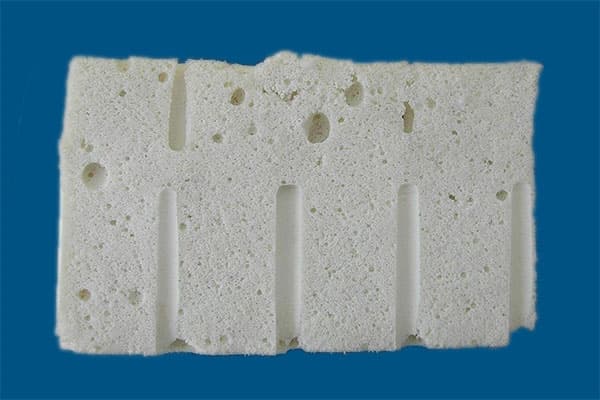
Reinforced reaction injection moulding is the clearest case. The fillers work the cavity surface away fastest around the gate. If the surface is etched, the difference between the gate area and the rest of the cavity is visible on the first part off the tool, and by about the fifth part the etch is only fragmentary. Dimensional accuracy goes the same way. For production parts, steel is the only sensible material. For a prototype or pre-series run, an aluminum tool needs hard coating with genuinely good sealing, or hard enamel. Hard anodising is not enough.
RIM
Unreinforced RIM is injected at 1,450 to 2,900 psi (100 to 200 bar), and the reaction generates at least 158 °F (70 °C), rising to about 194 °F (90 °C) in sections thicker than 0.4 in. (10 mm). That heat penetrates only about 0.06 in. (1.5 mm) into the metal, so the cavity skin tries to expand while the bulk of the mold does not, and the resulting shear in the metal is severe. Only high-copper alloys, EN AW-2017A and EN AW-2219, hold up. Rolled 7075 works at low quantities. Cast plate is not recommended for RIM at all, including ours.

Elastomers
Rubber processing is dominated by steel molds, for two separate reasons. Cast 5083 plate such as C210R handles the temperature without difficulty, but its strength falls far enough at working temperature that the mold deforms after only a few releases and thin features tear away, so only low-quantity prototypes are realistic. The 7000 series is ruled out on thermal stability. The 2000 series would be the obvious answer, except that several rubber compounds react catalytically with the copper in the alloy, and what comes out of the cavity is an adhesive mess that has to be dug out.
When a cavity gets damaged
The first instinct is usually to weld it. That is almost always the wrong move on an aluminum mold, for three reasons.
- Mold plate is usually a higher-strength aluminum. Welding causes local, total and irreversible softening, which can lead to outright failure of the repaired area.
- Most high-strength aluminum alloys, including C330R, are not weldable in the first place.
- The heat-affected zone changes the microstructure and the weld itself has a different structure again. Both change the local thermal conductivity. On some polymers that shows up on the finished part as a shadow or a colour change, sometimes called a phantom shadow, and it can appear even when the weld itself is invisible.
The better repair is an inlay: machine out the damaged area and shrink-fit a plug of new material. It costs more than a weld and it does not produce shadowing.
The inlay must be the same material as the mold. Shrink a C210R inlay into a C330R mold and the two have different thermal conductivity, so the inlay can print onto the moulded part as a clearly outlined geometric patch. Same alloy, same temper, same product.
Two constraints people find out about late
Food contact
Not every aluminum alloy is approved for food contact. DIN EN 602 governs it. The 5000 series and most of the 6000 series are approved. The 2000 and 7000 series are not. In G.AL® terms that means C210R and C250 are approved and C330R and C330 are not. If a 7000-series mold is used for something like yoghurt pots, it needs a food-safe surface treatment such as electroless nickel plating.
Etched textures
Where the cavity needs an etched grain, rolled plate in 5083, 6082 or 6061 gives a more even etch than any cast plate, ours included. This is a genuine limitation of cast plate and it is worth knowing before the tool is designed rather than after the first etch trial. If the texture is critical, ask us and we will say so.
The short version
- Cost the program, not the mold. On the study job, four aluminum molds at three times the tooling cost still came out 31% cheaper per piece.
- The saving is cooling time. Injection and hold do not change. Check what share of your cycle is cooling before assuming 40%.
- Unfilled resin, high volume: aluminum is usually right. Filled resin, R-RIM, elastomers, or PC: usually not.
- C210R is the default and covers most Canadian mold work. C330R when you need the strength or the extra tool life.
- Do not weld a damaged cavity. Use a same-material inlay.
Frequently asked questions
Can you use aluminum for production injection molds, or only prototypes?
Production, in the right conditions. In a GLEICH study of a 20,000,000 piece ABS part, G.AL® C330R molds ran the full program at 31% lower cost per piece than steel, using four molds against one. Aluminum is limited to prototypes when the resin is filled with glass, carbon or talc, in R-RIM, in elastomer work, and with polycarbonate.
How much faster is an aluminum injection mold than steel?
In the GLEICH study the cycle fell from 26.39 seconds to 15.83 seconds, a 40% reduction on the same part and machine. Almost all of that is cooling time, which fell from 18.72 to 8.58 seconds. Injection and hold pressure times were identical. If cooling is a small share of your cycle, expect a smaller saving.
Aluminum molds cost more because you need several. Is it still cheaper?
On a long-running job, usually yes. In the study, four aluminum molds cost CAD 172,632 against CAD 56,402 for one steel mold, roughly three times as much, and the program still finished CAD 499,770 cheaper. The result is not sensitive to the machine rate: aluminum wins on that job at any rate above about CAD 20 per hour.
What is the tool life of an aluminum injection mold?
It depends on the polymer, the part and how the mold is built and maintained. As guide values, G.AL® C330R reaches mid series (to 500,000 pieces) on PE, PP, PVC, PET-LT and polystyrene, small series (to 50,000) on PA 6/6, POM and PBT, and prototypes only on polycarbonate. G.AL® C210R usually sits one band lower, except at high mold temperature, where it does better than the stronger grades because 5083 cannot over-age. The full table covers 22 polymers. These are experience values and are not binding.
Which G.AL® grade should I use for a mold?
G.AL® C210R for most work: EN AW-5083 in O3 temper, precision sawn, and the grade most Canadian mold shops buy. G.AL® C330R when you need higher strength, more tool life or a mid-series run. C250 and C330 are the milled versions of each. C210R is also the better choice at high mold temperatures, because 5083 does not lose strength by over-ageing the way the 7000 series does.
Can I weld a damaged aluminum mold cavity?
Usually you should not. Most mold-grade aluminum, including G.AL® C330R, is not weldable, and welding causes local irreversible softening. The heat-affected zone also changes local thermal conductivity, which can print a shadow or colour change onto the moulded part even when the weld is invisible. Use a shrink-fitted inlay of the same material instead.
Is aluminum mold plate approved for food contact?
The 5000 series is, under DIN EN 602, so G.AL® C210R and C250 are approved. The 2000 and 7000 series are not, so C330R and C330 are not approved. A 7000-series mold used for food packaging needs a food-safe surface treatment such as electroless nickel plating.
Can an etched texture be put into a cast aluminum cavity?
Yes, but rolled plate in 5083, 6082 or 6061 produces a more even etch than any cast aluminum plate, including G.AL®. Where the etched grain is critical to the part appearance, rolled plate is the better substrate. Raise it before the tool is designed.
Where can I buy aluminum mold plate in Ontario?
GLEICH Aluminum Canada stocks G.AL® C210R, C250, C330R and C330 at Oldcastle, Ontario, about 15 minutes from the Windsor tool and die cluster, for pickup or same-week delivery across Essex County and Canada. Call +1 (226) 333-5083.
Availability in Canada
Stocked in Oldcastle, Ontario
G.AL® plate is stocked in Oldcastle, Ontario, roughly ten minutes from the Windsor-Detroit border. Standard formats ship the same or next business day to most of Southwestern Ontario, and across Canada on a freight quote.
Pickup is available Mon–Fri, 8:00 AM – 4:30 PM ET at 2555 North Talbot Road, Oldcastle, ON N0R 1L0, Canada. Every delivery includes the EN 10204 3.1 inspection certificate for that specific lot at no charge.
Off-cuts and remnant pieces are listed with exact dimensions and prices in the G.AL® Shop.
Your Aluminum Experts in Canada
Our Canadian team understands mold making. Tell us your application and we will recommend the right G.AL® grade, thickness, and format - and get you a quote fast.